
Came. Coming. Here.

First Sunday of Advent  – December 2, 2018 – Jeremiah 33:14-16; Luke 21:25-36 – Trinity Church, Winchester

Today we begin again. We begin a new liturgical year by waiting with patience and expectation for the One who is promised to us. We begin by waiting for Jesus.

We wait, not only for his coming in flesh, but also his coming in glory. Because we focus on both the incarnation and the “parousia,”Advent is an interesting time of the church year to say the least. It both completes and renews our annual liturgical cycle. It renews our year with the longing for Jesus’ birth and concludes it with the expectancy of his second coming. 

For this reason we might say that Advent is “a season under stress.” This stress makes for a season of some conflicting interpretations and practices. We see evidence of this conflict in today’s scriptures. One calls us to joyful longing and one to judgment and dread. [1]

“The days are surely coming,” we hear from Jeremiah, “when [the Lord] will fulfill the promise [he] made to the house of Israel and the house of Judah . . . I will cause a righteous Branch to spring up for David; and he shall execute justice and righteousness in the land.”

As Christians we understand Jeremiah’s interpretation of the coming Messiah to be fulfilled in the birth of Jesus Christ. This is a text of promise. It communicates our Christian hope of redemption and deliverance at the hand of the Messiah who comes, even as a baby. 

From Luke, on the other hand, we hear Jesus himself, at the end of his public ministry. “There will be signs in the sun, the moon, and the stars, and on the earth distress among nations . . . People will faint from fear and foreboding of what is coming upon the world, for the powers of the heavens will be shaken. Then they will see ‘the Son of Man coming in a cloud’ with power and great glory. Now when these things begin to take place, stand up and raise your heads, because your redemption is drawing near.” It sounds a lot like, “Lo, he comes with clouds descending.” 

Like today’s reading from Jeremiah, we can hear this passage from Luke as a text of promise. One day the Lord will come in glory to redeem us from the sin and destruction of this world. There’s hope!

However, the passage is scary and a little unsettling. We hear in it the dread that accompanies judgement. It is in this sense a text of terror. There will be distress on the earth. “People will faint from fear.” Watch out, Jesus warns, so that you are not caught off guard, as if in a trap.

Hearing eschatological, even apocalyptic, texts like this one, the Church seems to interpret them as either texts of promise or texts of terror. [2] But the two are not mutually exclusive. Advent reminds us to see them as both. The conflicting nature of these texts is not a bad thing; it is something to be cherished. 

Today’s texts remind us of Advent’s complexity, but they are not our only liturgical reminders of the ambiguous nature of the season. Throughout its history the Church has emphasized both penitential and anticipatory aspects of Advent. 

Some might silence the Gloria in favor of the Trisagion, as we have done, to emphasize a penitential component of the season. Some sacred ministers will wear deep purple—or even black—to orient worshippers toward a mindset of repentance in preparation for impending judgment. 

On the other hand, others prefer to emphasize the joyful expectancy of the incarnation by adding a bit of greenery to liven things up. My childhood parish used to decorate for Christmas before Advent 1. If you were to visit different parishes over the next three weeks you would see varied interpretations across our denomination. You will certainly see pieces of each in this parish.

The nature of this season beckons us to sit in tension for a while. Adopting either of these approaches wholesale—whether donning the metaphorical sackcloth of repentance or decorating the tree and singing carols—is not advised. The point of Advent is to live into its ambiguity. 

We don’t know much about the origin of Advent. If you’re interested, I can recommend some books on the subject like Waiting for the Coming by J. Neil Alexander. In it he tells us that one thing is clear from examining Advent’s somewhat fuzzy past: the church is not willing to settle for one story or another. Advent is not only about the judgement, hope, and expectation of the second coming or joyful longing and preparation for the incarnation. Advent is about participating in both of these realities. [3]

These two themes are inextricably intertwined for a very good reason–they remind us that our beginning is linked to our end. The Jesus who came is promised to come again. Our celebration and remembrance of the past and the hope and expectation of the future  meet in our present reality. 

Today’s collect helps us understand. Give us grace to cast away the works of darkness, and put on the armor of light now—in this mortal life in which your Son came to visit us in great humility; that in the last day, when he comes again in glorious majesty, we may rise to the life immortal.

Right here, right now, we know that the same Jesus who came, and is coming, is among us and working in us. You may have heard it before. It’s sounds a lot like…

“Christ has died, Christ is risen, Christ will come again.”

“We remember his death, we proclaim his resurrection, we await his coming in glory.” 

That’s past, present, and future. Jesus walked among us. Christ will come in judgement of us. The Risen Lord is with us now. Came. Coming. Here.

If you dwell in Advent’s ambiguity and wait patiently, you will learn the most valuable lesson of all. Jesus is with you now, even while you wait for him. You have a whole lot to look forward to in the future. You have a whole lot to celebrate about the past. But you also have a whole lot of living to do right now. The good news is that Jesus is with you, and he guides you along the way.

Remember him, as a vulnerable infant, Expect him, like a valiant figure in the clouds. But most of all, experience him in the flesh like his disciples always have, in the breaking of the bread and the prayers. 


[1] J. Neil Alexander, Waiting for the Coming: The Liturgical Meaning of Advent, Christmas, and Epiphany (Washington: The Pastoral Press, 1993), 23-24.

[2] Ibid., 20.

[3] Ibid., 24-26.
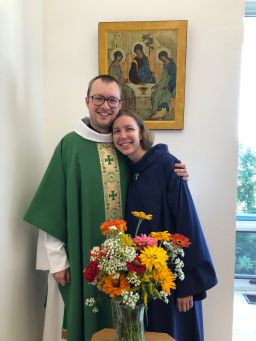
Persistence in prayer

Saturday after Proper 27B  – November 17, 2018 – Luke 18:1-8 – St. Mary’s Convent

I didn’t get to preach this *exact* sermon on Saturday because I kinda sorta…forgot it in the car, but we press on… Nevertheless, this is the version I prepared. 

If you pester God long enough, keep going to him with your problems, tell him just how deep you are in it, then he’ll finally help you. That was my first reaction after reading today’s gospel, but it doesn’t preach so well. It does tell us about the value of persistence, and that’s worth something, but it seems a word of grace should be built on a little more than annoying God. 

You see, it’s not persistence in pestering God that we’re after, it’s persistence in prayer. It is necessary to prayer constantly. Never give up on prayer. I’m speaking to an audience who gets it. You’ve turned over your lives to prayer. Why? Because it’s fun? I bet not! How often, when you’re in this chapel praying the daily office, do you look around and think, “Gosh, isn’t this a blast??!”

Maybe you do. If you do, you’re different than me. I don’t always think prayer is fun, but it is always necessary. If it feels like work, well, that’s because it is.

In Luke 17, the chapter just before today’s Gospel, Jesus tells his disciples that the coming kingdom of God is not exactly what they expect. “The kingdom of God is not coming with things that can be observed; nor will they say, ‘Look, here it is!’ or ‘There it is!’…”

Instead, he tells his disciples, “The days are coming when you will long to see one of the days of the Son of Man, and you will not see it…” In other words, there will be a time in which what you long for, you will not have. During that time, you’re going to have to pray. 

Enter the widow in chapter 18. Nothing is going right. She can’t even get justice from the courts because the judge has no regard for people or for God. Jesus is telling is disciples that there will be a time like this for them. And when it comes, they’ll have to pray. They’ll have to pray because they have no other choice. 

This parable teaches us not just that prayer is a good thing, but why prayer is a good thing. The widow has no choice but to keep bothering the judge. As people of relative privilege in comparison to the rest of the world, we often have many options at our disposal for changing our situations. But some people, like this widow, are desperate. They only have one option. Lucky for them, that option is God. They still have God. So they pray. 

When we have no other option, we still have God. So we pray. We pray, not because of our piety,  not because it’s fun, not to show off for others. No, we don’t pray to demonstrate our relationship with God. We don’t even pray because we have a relationship to God. We pray because prayer is our relationship with God. 

Prayer is faith in action. Unless we cry out day and night then what do we have? Certainly not faith. Certainly not hope. Certainly not a relationship with God. 

You all get it. That’s why you’re here. And I need not say much more about it. In fact, I think you might have a few things to teach me about prayer. So, let’s get back to it, shall we? 

“Prisoner of hope”

Saturday after Proper 23 – October 20, 2018 – Mark 12:8-12 – St. Mary’s Convent, Sewanee

When I first read the final lines of this passage I was relieved. “Do not worry about how you are to defend yourselves or what you are to say; for the Holy Spirit will teach you at that very hour what you ought to say.”

I guess I don’t have to prepare a sermon, I thought, the Holy Spirit will take care of it when the time comes. Alas, that’s not quite what Jesus is saying. Jesus is actually talking about coming times of persecution. The full quote goes like this:  When they bring you before the synagogues, the rulers, and the authorities, do not worry about how you are to defend yourselves or what you are to say; for the Holy Spirit will teach you at that very hour what you ought to say.”

He’s telling them that God will be with them, even when the evil days come. The Holy Spirit will aid them even when they think they have no hope. That’s precisely why blaspheming against the Holy Spirit is such a grave sin. 

The Holy Spirit, Jesus tells his disciples, is what will give them the power to stay faithful. These words are just as applicable to us as they were to Jesus’ disciples. In fact, they may be even more applicable on this side of the resurrection.

The Holy Spirit gives the Church the guidance to say what it needs to say and the power to say it. This is especially important to us during personal or corporate times of trial. If we denounce the Holy Spirit, or blaspheme against it, then we curse the source of the Church’s lifeblood. If we run around profaning the Spirit, then that will be fatal for the Body of Christ. 

The Holy Spirit is our hope, and hope is not to be mocked. If you give in to blaspheming the very life-giving Spirit of the Church then what other life will there be? What other hope will you have? 

This Holy Spirit stuff is serious business. It’s not just this thing that grabs ahold of the preacher when he preaches. It’s not just this thing that swoops down on the priest when she is ordained.

It is God, the holy and life-giving one, who sustains the Church on earth. His disciples didn’t know it that day, but we know it today; we know how the story ends. There will be persecution. But there will also be victory. There will be death, but there will also be glorious resurrection. 

I have a friend who wears a t-shirt that says, “Prisoner of Hope.” Prisoner of Hope. That pretty much says it all. It tell us that he knows the whole story.  You may be held hostage by the things of this world, but not me. The only thing that controls me is hope. That’s profound and hard. 

If you really know your bible, then you might recognize that phrase from the ninth chapter of Zechariah. “Return to your stronghold, O prisoners of hope; today I declare that I will restore to you double.” It speaks of God’s people who await a king who will speak peace to the nations. 

What if you heard that same word from God today? Could you claim that moniker for yourself? Are you a prisoner of hope?

Might as well be. What better option do you have?

Freedom to follow

21st Sunday after Pentecost – October 14, 2018 – Mark 10:17-31 – Christ Church, Alto, TN

We often hear today’s gospel passage cited as “the rich young ruler,” but that portrayal is the result of a mash up of all three different gospel accounts of this story. Matthew’s version calls the man both rich and young. Luke’s account calls him rich and identifies him as a ruler. Mark’s account, which we read today, really does neither. It does say he has a lot of possessions, and Jesus goes on to discuss wealth, so we take the point, but technically speaking, we make a lot out of this passage that is not actually there. 

Reading the passage as Mark has laid it out for us, I find nothing inherently entitled or snobby about the man who approaches Jesus. Some people identify him as pretentious; they think he’s trying to prove something. Those are largely editorial comments which we lay over the text instead of letting it speak to us as it is. 

Let’s review what we get from today’s text. Jesus is about to leave town and a man runs up and kneels before him. The man asks, “What must I do to inherit eternal life?” 

“You know the commandments,” says Jesus, “Don’t murder, commit adultery, steal, lie, or defraud. Honor your father and mother.” “I have kept all of these,” says the man. 

Jesus looks at him lovingly and says, “You still lack one thing: sell everything you own, give the money to the poor, and then come follow me.” 

The man goes away grieving because he has many possessions. Well, wouldn’t you? If after trying to live the best life you could someone told you that you still needed to get rid of all your material goods, wouldn’t that make you a little sad? 

It’s a lot to ask of someone, even if you’re not wealthy. Perhaps especially if they’re not wealthy. Material goods aren’t all frivolous; they provide us comfort and make living life possible (at least the way we are accustomed to living it). There’s nothing wrong with grieving the loss of the material things in your life. Right now there are thousands of people in the Florida panhandle doing just that in the wake of Hurricane Michael. 

My spouse constantly urges me to go through my closet. “You have too many clothes,” he says, “You don’t even wear them all.” He’s right. So a few weeks ago I went through them and donated a huge trash sack full. It did, I hate to admit, involve some grief. All change does, even if it’s just donating old clothes. 

What if we don’t think of the man in our story as a spoiled rich kid? Instead, what if we think of him as a man who comes to Jesus to ask a legitimate question? “What must I do to inherit eternal life?” In response, Jesus is honest with him. 

I think that’s a question we all struggle with. I do, even as a priest of the Church. What must I do? What must we do? (As if it’s in our control.)

When the man asks this question Jesus says, “You know the commandments.” “Yes, and I keep them all,” the man replies. 

We all know the Ten Commandments. Even if we can’t name them in order, we can probably get somewhere close. We learned as kids that these are rules to follow in order to follow God. We do our best to keep them. 

But there’s more, Jesus tells us. The commandments are only a part of the deal. You still lack one thing: “Sell what you own, give the money to the poor, and then come follow me.”

If you ask me, that sounds like three things. Sell, give, follow. But I think Jesus is really getting at the “follow me” part. It’s just that those first two things—selling your possessions and giving the money to the poor—are prerequisites to doing the third thing well. 

In order to follow Jesus we have to give up the things that tie us to this earthly realm. We have to get rid of the things that distract us from the capital-T Truth. It’s ironic. The one thing we lack is getting rid of all the things we have. What we lack is what we have. 

People have been following this teaching for centuries. St. Francis, whose feast day we celebrated with a blessing of the animals last Sunday, is well known for casting aside his great wealth in order to follow Jesus. He famously removed all his clothes upon his conversion as a way of renouncing his reliance on material goods. To this day monks and nuns take vows of poverty in order to focus more singularly on a vocation of service to Christ. By unshackling themselves from the goods that bind them to realities of this world, they find a freedom to follow their God with everything that are, by giving up everything that they have. 

Their example is one for all of us. In order to follow Jesus we have to completely reorient our lives. If you really want to inherit eternal life, then go free yourself of all of the stuff that weighs you down—whatever it is—and then come back and follow Him.

We’ve seen this before in the Gospel. Remember when Jesus called his disciples? He said, “Leave your boats, leave your nets, leave your parents, and come follow me.” 

Your material possessions are just things, but Jesus is the way, the truth, and the life. What you lack is what you’re hanging on to.

Peter heard it, Andrew heard it, James and John heard it. Maybe we would know this man’s name if he had done the same. Maybe he’s the would-be thirteenth apostle who couldn’t quite comes to terms with the real cost of following Jesus. 

What keeps you from realizing your freedom to follow Jesus? Is it something that you cling to? Is it something that you need to take out and put on the curb?

I imagine there is something, but I don’t say that to judge you. I think it’s true of everyone. It’s our nature. We cling to things instead of God. Those things can get in the way of our relationship with God. 

It may be money. Or it might be something else. For some people in this great nation of ours it’s their approval rating. For other people it’s always being right. Being able to prove that you are right and know more than everyone else, that’s the problem. Putting too much stock in your own opinion of your knowledge of the facts will get in the way of God. 

For some it’s fear, a palpable sense of dread that they face waking up every morning. Some can’t stand facing a world that they are convinced is utterly hopeless. 

Is it any of those things, or is it something different? I’m not telling you literally to sell everything you own. I don’t think that would be in our best interest, but I do urge you to think about what separates you from God. What do you lack? Go to a quite place this week, and search for the answer. When you find it, take it to the curb, tie it down, or burn it with a pile of autumn leaves, and be free.

Redefining relationships

20th Sunday after Pentecost – October 7, 2018 – Mark 10:2-16 – Trinity Episcopal Church, Winchester, TN

Mark’s account of Jesus’ teaching on divorce may make us a bit uncomfortable. Divorce is a hard topic even without the lectionary rubbing our noses in Jesus’ thoughts about it. 

In public Jesus answers the Pharisees, “From the beginning of creation, ‘God made them male and female.’ ‘For this reason a man shall leave his father and mother and be joined to his wife, and the two shall become one flesh.’ So they are no longer two, but one flesh. Therefore what God has joined together, let no one separate.”

You may recognize that last part from the Prayer Book. (We got it from the Bible, not the other way around.)

What are we Episcopalians to make of this? We allow people to get divorced. Have we completely forgotten what Jesus told us? A marriage should last forever! 

If I were a pessimist, I’d say we got this one wrong. But lucky for me, I’m not. Rest assured, we still belong to a faithful church. Christians have never exactly been clear on divorce, even dating back to Paul and the first gospel accounts. 

In 1 Corinthians 7 Paul gives some conflicting advice about marriage between believers and nonbelievers and who is allowed to divorce whom. Matthew’s account of the same story we read today includes an exception for adultery to Jesus’ no divorce rule. 

Our understanding of divorce still varies widely today. In some traditions divorce is forbidden. In others annulment is required before remarriage is permitted. It’s important to understand what Jesus is telling us when he condemns divorce so that we know what to make of it. In order to figure it out, how about some context? 

In Old Testament times marriages were all about money. Marriages were largely arranged between the groom-to-be and the father of the bride. They were business transactions, and women had no say in the whole thing because they were treated as property. Divorce happened when a man wanted it. 

When Jesus quoted Genesis to the Pharisees I bet he surprised them. Jesus is doing what he always does, he’s turning expectations upside down. The Pharisees ask him if he agrees with the law of Moses, and he quotes back a different part of the scripture to prove a different point.

When a couple is joined together they become one flesh, says Jesus. This is not about money or property, this is about relationship. Marriages are about two becoming one flesh; marriages last for a lifetime, not just until the husband decides write a certificate of divorce. Marriage is about mutuality and respect, not obedience and inheritance. 

Sometimes when I read this passage and hear Jesus say, “No divorce allowed!” I hear him being unfair and close-minded. I hear Jesus prohibiting something that is occasionally necessary for healthy people in unhealthy relationships. I immediately think of the woman abused by her husband or the child that can’t escape the rage of an unfit or dangerous parent. Wouldn’t divorce be acceptable then? 

In my haste to prove how progressive I am, I list all the reasons why divorce is, at least sometimes, OK. Well, it may be. After all, Jesus is sensitive to those with irregular or damaging relationships. For proof of this we need look no further that his conversation with the Samaritan woman at the well. 

This much is clear: Jesus cares about our relationships and our unique circumstances as much as we do. He is not prohibiting divorce in order to force someone to stay in an abusive relationship. That’s a whole different situation and one that has its own tragic struggles a hard choices. Jesus doesn’t make these comments to prohibit people from getting out of bad relationships. Jesus makes these comments to redefine what marriage should be in the first place. It’s kind of ironic: through his comments on divorce, Jesus redefines marriage. 

Sure, the ancient Israelites had laws about marriage and divorce, just like we do. But Jesus says that those laws stem from hardness of heart, not desire for healthy relationships. 

Laws that formally govern legal relationships are necessary. We don’t want people entering and leaving marriages or business partnerships willy-nilly. Relationships are important to society, and we need to protect them for the very sake of the relationship itself, not for the sake of the selfish and the greedy who are only interested in an escape clause.

You can’t get divorced just because you find someone more appealing. You can’t abandon a commitment, just because you’re “over it.” The unity and mutuality that are the cornerstones of marriage mirror God’s relationship with humanity. You just can’t give up on that for any old reason.

Sometimes, even given the laws that exist, human relationships fail, and that’s OK. God’s grace can handle that, but that grace should not obscure our knowledge of God’s desire for our relationships in the first place.

How do you handle your relationships? That’s the question Jesus is asking us. How do we deal with honoring them, with nurturing them, with blessing them. How do we deal with them when they are broken? Do you just give up, or do you do the hard work of trying to fix them?

You’ve been part of a broken relationship, no doubt? It doesn’t’ have to be a marriage. We all get cross with people. Rumors spread, promises are broken. “I’m never talking to him again!” God asks for more from us. God asks us to view everyone as sacred. God asks us to recognize that people are not disposable. God asks us to act like relationships are two-way streets, because they are.

I have a confession to make, on Friday night I backed my truck into Walker’s car right in our driveway. I still feel bad. When I walked back in the house the first thing he said to me was, “I love you.” He wasn’t happy about it, but that’s what he said.

Can you imagine? I’m telling you this, not to put my own relationship up on a pedestal, but to illustrate a little piece of the kingdom of God, a piece that I didn’t necessarily deserve, but that Walker freely offered out of his commitment to me and to our relationship. 

That’s what the kingdom of God is like. That’s what Jesus is asking of us. 

Now, don’t get confused. Walker is not God—far from it! Neither am I, and neither are you. But when it comes to our relationships, we can all act like we know Jesus, because we do.

Translating the Word

Commemoration of William Tyndale and Miles Coverdale – October 6, 2018 – St. Mary’s Convent

Today we celebrate William Tyndale and Miles Coverdale, two Holy Men of God known for their efforts in translating the Bible into English. This is not one of our most popular feast days, but it is one that ought to remember. 

If it weren’t for the work of these two, our Bibles would look—and sound—quite different. We often take for granted our translations of the Bible. We forget that it all started out in Hebrew and Greek. 

Ever since the scriptures were first translated it has become and ever-evolving project. There are now thousands of translations that seek to share, with diverse audiences, the Good News of Jesus Christ.

In fact, there’s even a version of the Bible called “Good News.” And then there is The Message. Now that’s relevant sounding! The NRSV is what we read from today. Our church used to use the RSV. And before that the KJV. Then of course there’s the NIV, which is popular in some protestant circles. 

If you ask a Roman Catholic they are likely to tell you that they use the New American or New Jerusalem Bible. And don’t forget about the CEV, which sounds a lot like the newer CEB, but is actually quite different. 

It’s amazing, all these versions that we’ve come up with. I suppose somewhere amidst this alphabet soup exists the truth that we all long for. Today we thank God for the scholars who made it possible for all of us to read it. They changed our lives before we even lived them. 

Remember, all translation is interpretation. Each time someone translates a word from one language into another language they have to make choices. It is not as if each word in Greek or each word in Hebrew has one exact counterpart in English. The opposite is true. 

For example, what’s the difference between a thief, a bandit, a robber, and a burglar?And which Spanish equivalent best describes each? That’s not an easy question to answer. I know because I had to try on an exam once. 

You think that’s a lot of pressure? What about being responsible for generations of people understanding the word of God? Yikes! 

This is to say, the work of Tyndale and Coverdale, like all human work is probably imperfect. But that’s OK. The goal of our lives together is not about getting every word of the translation perfect, it’s about developing a relationship with the Word, Jesus Christ. 

The work of Tyndale and Coverdale has allowed us not just to read the word with trusted accuracy but to communicate the capital-W Word of God. They made the Bible assessable to us, and now we get to make it accessible to others, not by looking up words in dictionaries or drilling verb forms, but by living like we know Jesus. 

And we do know him, not only because of Tyndale and Coverdale, but because he is among us now, just as he was with his first disciples, in the breaking of the bread and the prayers. 

One such child

18th Sunday after Pentecost – September 23, 2018 – Mark 9:30-37 – Trinity Episcopal Church, Winchester, TN

After hearing today’s Gospel passage we may be tempted to dwell on the image of the child. Young, sweet, innocent. Imagine the little ringlets of hair, the brilliant blue eyes, and the curious little fingers. The image of the child sticks with us for good reason. There is a lot to admire about childhood. It’s largely carefree. 

In one of my favorite TV shows, 30 Rock, Pete says to his cranky coworker Liz Lemon, “I hope you’re happy!” “Not since I was a child,” she replies.

Adults often long for the simplicity of childhood. No bills to pay. No working day. No headaches or office cubes under buzzing florescent lights.

Bring a child into the hustle and bustle of everyday life and everything gets better, even if just for a moment. A mother brings her newborn the the office to visit her daddy and it provides a nice break for everyone. “Oh my gosh she is so cute.” 

Take a baby into a nursing home, stand back and soak in the smiles and the memories cast on the faces of the elderly residents.

Whenever we see a child we get that beautiful feeling. Their energy is rejuvenating. Something in their rosy cheeks offers us a an escape. 

We’ve all seen the woman in the grocery store pushing her cart down the aisle. When she see a young father pushing his baby she stops to smile and wave, lost in infant’s gaze.

Maybe this is why so many stained-glass windows depict Jesus with children. They add freshness to our mundane lives. (At least as long as we’re not with the all the time.)

I really do think we idealize childhood. But—make no mistake about it—Jesus does not. Don’t let yourself get caught up in childhood sentiments. Pay attention to the rest of the story. Jesus is lifting up the virtues of childhood for a very different reason than sentimentality. 

His disciples argue about who is the greatest, and he gives them a reality check. The greatest is not the biggest or the strongest or the smartest. The greatest is the one who welcomes a child such as this. Jesus does not show off the kid because the kid is adorable. Jesus redefines the cultural hierarchy of his day by dramatically elevating the status of the child. 

“If you welcome a child you welcome me.” These words turn the value system of the day upside down. In ancient Palestine children didn’t have rights. A father could sell or trade his own child with no repercussion. 

This is not to say that parents didn’t love their children. I’m sure the opposite was true, but there were different economic realities. People didn’t have kids simply for procreation, they also needed people to work on the family farm or in the family trade. Jesus turns this child, much more than a helping hand, into someone who is honored and revered.

Today we may be more sentimental when it comes to kids, but if we’re honest with ourselves, we still have a tendency to devalue childhood. As far as our culture is concerned children exists to grow up. They are simply biding their time until they can function as productive members of society. They are in training for the “real world.” 

When someone fails to mature fast enough we criticize them. “Oh grow up!” “Get your head out of the clouds!” “I’m not always going to be here to clean up your mess!” “If you can’t even put your name on your paper how are you going to get a job?”

However, Jesus helps us reimagine the value of childhood.He doesn’t do it by highlighting their adorable characteristics or exploiting our emotions. Instead, Jesus illuminates the virtues of childhood. Jesus shows us that children are the receivers in life. They receive their life from others. Literally. 

They exist because others make it possible for them to exist. I new mom once who told me, “All I remember about the ride home from the hospital is how nervous I was.” The child completely depends on them. Sure, the parents create the child together but they also continue to give it life after it is born: fresh milk, clean diapers, loving touch. 

Adults are the givers life. They are the ones in control. They change the diapers and warm the milk. Adults earn the money, keep the lights on, make the beds, and drive the carpool. Parents offer punishment: Time out. No dessert. “Go to your room.” The grown ups are in control. But the children do what they are told. They can’t even walk for almost a year. 

Jesus reminds us in the presence of a child what it truly means to be child-like. It’s not about being cute and naive; it’s about facing the reality of our dependence.  To be child-like is to depend on others. 

We all depend on others. The farmers that grow our food, the teachers who teach us how to think, the friends who support us when we are alone. Even the water treatment plant workers, the electrical linemen, and most of all, God. 

If you want to be at the top the hierarchy, if you want to rank first in the kingdom of God, then you have to remember that you depend on others.

My mother has had the rare experience of her own mother becoming like her child. My grandmother has Alzheimer’s and can’t care for herself like she used to. My mom to prepare her meals, dresses her, and combs her hair. 

Do you remember what it was like to depend on others? To really rely on others and be completely at their mercy? It may be a time when you were extremely sick or broke your leg and you couldn’t do anything for yourself. 

Jesus is urging us to remember what it was like to receive help from others so that we will will in turn be quick to serve others in return. 

Jesus says, “If you want to be greatest, don’t focus on yourself, focus on those in need. You need to recognize the holiness of the people on the bottom rung of society. If you want to be the best, you’ve got to serve others because people depend on you.”

A really good way to remember that is to remind yourself that you depend on others. “If you really want to welcome me, you’ve got to welcome this child. Not because the child is innocent, not because he child is cute or sweet, but because the child depends on you.”

A child of God is anyone who depends on others for survival. When you serve those who depend on you, you serve God. Serve all of God’s children in need. Anyone who is hungry, or thirsty, or naked. Serve anyone on the receiving end of life. Serve all who are controlled by others. Serve the powerless and manipulated. Serve the slaves. The widows. The orphans. The oppressed. The poor. The outcast. The refugee. The criminal. It is in the prison cell, the refugee camp, and the Social Security line that you will meet the God who himself ended up completely at the mercy of others.

So make haste! We don’t have much time. Even now we are passing away. We are people of a servant Lord who stooped to wash the feet of his disciples and in so doing taught us that whenever we wash someone’s clothes or buy someone’s lunch or help someone change a flat tire that we are serving Him who first served us. The One who taught us that by feeding our 88-year-old mother we might glimpse the One who gave himself to be food for others.

This is our loving God: the one we meet these beautiful moments of self-sacrifice. The very God that they disciples could not yet recognize, but that we have known all our lives. The very One who gives us greater joy than even the cutest little baby.

… and be grateful

42309044_235514037130229_6190254780821012480_nEmber Day – September 22, 2018 – Exodus 19:3-8; 1 Peter 4:7-11; Matthew 16:24-27 – St. Mary’s Convent

I was delighted to preside at the Eucharist at St. Mary’s Convent in Sewanee this morning. Below is my sermon. To learn more about the Community of Saint Mary visit their website here

Today’s lessons come with a lot of instructions. In each of them God tells his people what they should do. 

In Exodus, God gives Moses a message for the Israelites. “Tell my people that if they obey my voice and keep my covenant, then they shall be my treasured possession out of all the peoples. The whole earth is mine, but you shall be for me a priestly kingdom and a holy nation.” If you obey me then you will be my people. 

The author of 1 Peter gives us some suggestions about community living. “Therefore be serious and discipline yourselves for the sake of your prayers. Maintain constant love for one another. Be hospitable to one another (without complaining). Use your God-given gifts to serve one another.” 

And in Matthew’s account Jesus himself tells his disciples, “If any want to become my followers, take up your cross and follow me.” 

It’s a lot to take in on a Saturday morning. Obey me. Keep my covenant. Love each other. Be hospitable. Serve. Pray. Take up your cross. Follow me. 

These things can read like a to-do list, and that makes me a little uncomfortable.  We are Episcopalians, products—whether we like it or not—of a blessed reformation. A reformation that told us, it’s not about what we do; it’s about what is done for us on the cross and the promise of resurrection. 

So why all these instructions? Can God just not help himself? 

Maybe God, like my own father, in an effort to show me how much he cares about me, and how much he loves me ends up…sometimes…kinda sorta…telling me how to live my life. 

Sometimes it feels like my father’s well-intentioned advice, is his way of piling on to my work load. “You might consider calling your mother more.” “When was the last time you talked to you grandfather.” “Have you mailed those insurance papers yet?”

My husband does it, too. “That was really nice of them; you should write a thank-you note.” “Have you considered inviting her for coffee.”

OK. Whatever. Great. Wonderful. All good ideas, but I’m a little busy here.  

“Well, I’m not trying to make your more difficult,” they say,  “I’m just trying to help!”

And then it dawns on me! Obey my commandments. See my covenant for instructions. Love each other. Be hospitable. Serve each other. Pray. Take up your cross. God’s just trying to help. 

God doesn’t make lists of tasks for us because God needs us to prove something. God provides examples so we don’t have to figure it out all by ourselves. God knows exactly what he’s doing. I’m the one turning it into a to-do list. 

All of these things: love, service, hospitality, scripture reading, and prayer are appropriate ways not to earn our salvation, but to respond to it with gratitude. 

Isn’t that liberating? You don’t have to do anything to earn God’s favor. So cross it all off your to-do list, and be grateful.

Our partiality problem

16th Sunday after Pentecost – September 9, 2018 – Proverbs 22:1-2, 8-9, 22-23; James 2:1-17; Mark 7:24-37 – Trinity Episcopal Church, Winchester, TN

Today the lectionary provides us with an embarrassment of riches. Today’s lessons at first feel and seem quite different from one another but upon closer examination, they work together to offer us a very important lesson about distinctions (or lack thereof) between God’s people. 

From James we hear, “If a person with gold rings and in fine clothes comes into your assembly, and if a poor person in dirty clothes also comes in, and if you take notice of the one wearing the fine clothes and say, “Have a seat here, please,” while to the one who is poor you say,  “Stand there,” or, “Sit at my feet,” have you not made distinctions among yourselves, and become judges with evil thoughts? 

Proverbs is, perhaps blessedly, more brief. “The rich and the poor have this in common: the Lord is the maker of them all.”

These two passages reveal a truth that we often forget. The distinctions that we make between people who are rich and people who are poor are our distinctions, not God’s. God created all of us. In America we sometimes hear it as, “All [men] are created equal.” 

Today we also have the Gospel according to Mark, from which we hear two healing stories—two miracles. 

One is about a Syrophoenician woman who goes to Jesus to ask for help for her sick daughter. This woman is a Gentile. In Jesus’ world, a world of Jews, she does not belong.  She takes the chance because she is desperate. He heals her daughter. 

In the next scene some folks bring Jesus a deaf man with a speech impediment. Because this takes place in the Decapolis, it’s likely that he is also a Gentile. They beg Jesus to lay hands on him. Jesus takes the man aside, puts his fingers into his ears, spits, and touches his tongue. “Ephphatha,” he says, and the man is healed. 

Jesus performs these saving acts on two people who do not belong to his community, two people who should never have belonged to his community. 

Knowledge of this, combined with what we have already heard from Proverbs and James reinforces what we are told again and again: God shows no partiality. God made both rich and poor. God loves all people equally, no matter what side of the tracks they’re from, no matter what community they belong to. 

You can’t believe in Jesus and give special treatment to the rich, or privilege members your own community. The Bible tells us and shows us that Jesus shows mercy to people who are *supposed* to be excluded. 

Jesus goes out of his way to help people that the religious leaders of his day are not to keen on. Even when he is tired, or wants to be alone, he makes time for people that the world has forgotten. 

Imagine that. It really was radical. And, unfortunately, it still is. I’ve heard people tell themselves, “Oh, I don’t see color” or  “I don’t judge,” but there truth is, they do. 

And worse than the stigmas, stereotypes, and snap judgments that we make, is pretending that we don’t make them at all. Instead of facing up to the realities of our participation in systematic oppression we find it easier to ignore any sense of guilt. 

The truth is, we still exclude— not just women, gays, and racial minorities. We exclude all kinds of people who are different than us. I know a student who is on the autism spectrum. He is not able to communicate clearly and confidently with others. He cannot interact socially to the same degree that his peers can. His peers struggle to relate to him precisely because he struggles to relate to them. 

It’s easier to give up or crack a joke to with your friends when he takes the whole class off on a tangent than it is to try to be supportive. 

The same is true when people get sick. Congregations often jump into overdrive When a member is diagnosed with a serious illness. Members bring mounds and mounds of cut up fruit, vegetables, lasagna, and cookies. 

But would you believe that sometimes after a person receives a bad diagnoses, that some people say nothing at all? Some people are afraid they will make a mistake or will not be able to relate. Some people fear that they won’t say the right thing, so they choose to say nothing at all. 

Typical. We all do it. 

Those are the rules of this world, but as Christinas we are called to be different. We know that God’s kingdom is not a kingdom of this world. We are called to live by the rules of God’s reign. No matter who wears what, or says what, or does what, we remember that God is the father and mother of us all. 

That’s hard work. It’s hard because we haven’t all been women, or queer, or a minorities. It’s hard because we don’t always understand difference—of any kind.

We haven’t all had direct experience with autism. We haven’t all been diagnosed with Leukemia or Parkinsons. When faced with differences fear gets ahold of us. Even around people we know and love, we don’t know what might help and what might make things worse.

We just refuse to treat people differently because we don’t want to give those who are different from us “special privileges.” In this country we think that if some people get special privileges then we might lose some of ours. We assume that there has to be inequality. But Jesus showed us that’s not the case when he died for us all. 

God shows no partiality. God’s saving acts are for everyone. Salvation is God’s work among all people. Jesus shows us that it belongs not only to Jews but to Gentiles, too. Even a Syrophoenician. Even a deaf man. Even poor people. Even rich people. 

We don’t obtain our salvation by ourselves. It comes from the one who loved us so much that he gave himself for us. The very same one who stands alongside those who are different from us and shows us that when we love them we love him. That’s salvation. 

James says, “Has not God chosen the poor in the world to be rich in faith and to be heirs of the kingdom that he has promised to those who love him?” Yes, and the autistic, and the sick, and the queer, and the women, and the men, and the blacks, and the whites, and the Mexicans, and the Muslims.

God created us all, and he loves us more than we could ever ask or imagine.