Ember Day – September 22, 2018 – Exodus 19:3-8; 1 Peter 4:7-11; Matthew 16:24-27 – St. Mary’s Convent
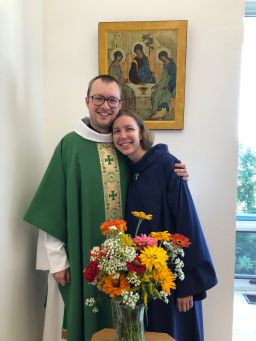
I was delighted to preside at the Eucharist at St. Mary’s Convent in Sewanee this morning. Below is my sermon. To learn more about the Community of Saint Mary visit their website here.
Today’s lessons come with a lot of instructions.In each of them God tells his peoplewhat they should do.
In Exodus,God gives Moses a messagefor the Israelites.“Tell my people that if they obey my voice and keep my covenant,then they shall be my treasured possessionout of all the peoples. The whole earth is mine,but you shall be for mea priestly kingdom and a holy nation.” If you obey methen you will be my people.
The author of 1 Petergives us some suggestionsabout community living.“Therefore be seriousand discipline yourselvesfor the sake of your prayers. Maintain constant love for one another. Be hospitable to one another(without complaining). Use your God-given gifts to serve one another.”
And in Matthew’s account Jesus himself tells his disciples, “If any want to become my followers, take up your cross and follow me.”
It’s a lot to take in on a Saturday morning.Obey me.Keep my covenant.Love each other.Be hospitable.Serve.Pray.Take up your cross.Follow me.
These things can read like a to-do list,and that makes me a little uncomfortable.We are Episcopalians,products—whether we like it or not—of a blessed reformation.A reformation that told us,it’s not about what we do; it’s about what is done for us on the cross and the promise of resurrection.
So why all these instructions?Can God just not help himself?
Maybe God, like my own father,in an effort to show mehow much he cares about me, and how much he loves me ends up…sometimes…kinda sorta…telling me how to live my life.
Sometimes it feels like my father’swell-intentioned advice,is his way of piling on to my work load. “You might consider calling your mother more.” “When was the last time you talked to you grandfather.”“Have you mailed those insurance papers yet?”
My husband does it, too.“That was really nice of them; you should write a thank-you note.”“Have you considered inviting her for coffee.”
OK. Whatever. Great. Wonderful.All good ideas, but I’m a little busy here.
“Well, I’m not trying to make your more difficult,” they say, “I’m just trying to help!”
And then it dawns on me!Obey my commandments. See my covenant for instructions. Love each other.Be hospitable.Serve each other.Pray.Take up your cross. God’s just trying to help.
God doesn’t make lists of tasks for us because God needs us to prove something.God provides examples so we don’t have to figure it out all by ourselves.God knows exactly what he’s doing.I’m the one turning it into a to-do list.
All of these things:love,service,hospitality,scripture reading,and prayer are appropriate ways not to earn our salvation,but to respond to it with gratitude.
Isn’t that liberating? You don’t have to do anything to earn God’s favor.So cross it all off your to-do list, and be grateful.
16th Sunday after Pentecost – September 9, 2018 – Proverbs 22:1-2, 8-9, 22-23; James 2:1-17; Mark 7:24-37 – Trinity Episcopal Church, Winchester, TN
Today the lectionary provides uswith an embarrassment of riches.Today’s lessons at first feel and seem quite different from one another but upon closer examination,they work together to offer usa very important lesson about distinctions (or lack thereof) between God’s people.
From James we hear,“If a person with gold ringsand in fine clothescomes into your assembly,and if a poor person in dirty clothes also comes in,and if you take noticeof the one wearing the fine clothes and say,“Have a seat here, please,”while to the one who is poor you say,“Stand there,” or, “Sit at my feet,”have you not made distinctions among yourselves,and become judges with evil thoughts?
Proverbs is, perhaps blessedly, more brief. “The rich and the poor have this in common: the Lord is the maker of them all.”
These two passages reveala truth that we often forget.The distinctions that we make between people who are richand people who are poorare our distinctions,not God’s. God created all of us.In Americawe sometimes hear it as,“All [men] are created equal.”
Today we also have the Gospel according to Mark,from which we hear two healing stories—two miracles.
One is about a Syrophoenician woman who goes to Jesusto ask for help for her sick daughter.This woman is a Gentile.In Jesus’ world,a world of Jews, she does not belong. She takes the chance because she is desperate.He heals her daughter.
In the next scene some folks bring Jesus a deaf man with a speech impediment. Because this takes place in the Decapolis,it’s likely that he is also a Gentile.They beg Jesus to lay hands on him.Jesus takes the man aside,puts his fingers into his ears,spits, and touches his tongue.“Ephphatha,” he says, and the man is healed.
Jesus performs these saving actson two people who do not belongto his community, two people who should never have belongedto his community.
Knowledge of this,combined with what we have alreadyheard from Proverbs and Jamesreinforces what we are toldagain and again: God shows no partiality.God made both rich and poor.God loves all people equally, no matter what side of the tracks they’re from, no matter what community they belong to.
You can’t believe in Jesusand give special treatment to the rich, or privilege members your own community.The Bible tells us and shows usthat Jesus shows mercyto people who are*supposed* to be excluded.
Jesus goes out of his wayto help people that the religious leadersof his day are not to keen on.Even when he is tired,or wants to be alone,he makes time for people thatthe world has forgotten.
Imagine that.It really was radical.And, unfortunately, it still is.I’ve heard people tell themselves,“Oh, I don’t see color” or“I don’t judge,” but there truth is, they do.
And worse than the stigmas,stereotypes, and snap judgmentsthat we make, is pretendingthat we don’t make them at all.Instead of facing up to the realities of our participationin systematic oppressionwe find it easier to ignoreany sense of guilt.
The truth is, we still exclude—not just women,gays,and racial minorities.We exclude all kinds of people who are different than us.I know a student who is on the autism spectrum.He is not able to communicateclearly and confidently with others.He cannot interact sociallyto the same degree that his peers can.His peers struggle to relate to him precisely because he struggles to relate to them.
It’s easier to give up or crack a joke to with your friendswhen he takes the whole class off on a tangent than it is to try to be supportive.
The same is true when people get sick.Congregations often jump into overdrive When a member is diagnosedwith a serious illness.Members bring mounds and moundsof cut up fruit, vegetables, lasagna, and cookies.
But would you believe that sometimesafter a person receives a bad diagnoses, that some people say nothing at all? Some people are afraid they will make a mistake or will notbe able to relate. Some people fear that they won’t saythe right thing,so they choose to say nothing at all.
Typical.We all do it.
Those are the rules of this world, but as Christinas we are called to be different.We know that God’s kingdomis not a kingdom of this world.We are called to live by the rules of God’s reign. No matter who wears what,or says what,or does what,we remember that God is the father and motherof us all.
That’s hard work.It’s hard because we haven’t all been women,or queer,or a minorities. It’s hardbecause we don’t always understand difference—of any kind.
We haven’t all had direct experience with autism. We haven’t all been diagnosed with Leukemia or Parkinsons.When faced with differencesfear gets ahold of us.Even around people we know and love,we don’t know what might helpand what might make things worse.
We just refuse to treat people differently because we don’t want to give those who are different from us“special privileges.” In this country we thinkthat if some people get special privilegesthen we might lose some of ours.We assume that there has to be inequality. But Jesus showed us that’s not the casewhen he died for us all.
God shows no partiality. God’s saving acts are for everyone.Salvationis God’s work among all people.Jesus shows us that it belongsnot only to Jewsbut to Gentiles, too. Even a Syrophoenician.Even a deaf man.Even poor people.Even rich people.
We don’t obtain our salvation by ourselves.It comes from the onewho loved us so much that he gave himself for us.The very same one who standsalongside those who are different from us and shows us that when we love them we love him.That’s salvation.
James says,“Has not God chosen the poor in the worldto be rich in faith and to be heirs of the kingdomthat he has promisedto those who love him?” Yes,and the autistic,and the sick,and the queer, and the women, and the men,and the blacks, and the whites, and the Mexicans, and the Muslims.
God created us all,and he loves us more than we could ever ask or imagine.
15th Sunday after Pentecost – September 2, 2018 – Song of Solomon 2:8-13 – Trinity Episcopal Church, Winchester, TN
I regret not recording this sermon in some way. As a relatively new preacher, I’m still learning how sermons take shape in the unique moments of their unfolding. This one was prone to several additions and adaptations. As the living word of God, a sermon is meant to be absorbed by the ear. It is an event in time and not–as it appears here as text on a page–an object in space. Alas, this is what remains.
**********
The voice of my beloved!Look, he comes, leaping upon the mountains bounding over the hills. My beloved is like a gazelle or a young stag. Look, there he stand behind our wall gazing in at the windows, looking through the lattice. My beloved speaks and says to me: “Arise, my love, my fair one, and come away; for now the winter is past, the rain is over and gone. The flowers appear on the earth; the time of singing has come and the voice of the turtledove is heard in our land. The fig tree puts forth its figs,and the vines are in blossom;they give forth fragrance. Arise, my love, my fair one, and come away.”
I’m not sure it’s a good idea, but I’m going to preachon the Song of Solomon today.I’m not sure it’s a good ideabecause some of the content here is kind of. . . sensitive.It’s about. . . passionate love.You know—sex.
I don’t know if we’ve reached the pointin our relationshipwhere we can talk about such things.In fact,I’m not even sure what the proper stage isin the relationship betweena pastor and his congregationwhen such talk is acceptable. Technically, I’m not even a priest yet,and I won’t be for a couple more weeks.
But, here it goes . . .
Today’s passage fromthe Song of Solomonis one of the only excerptswe get from this entire bookin the three-year rotationof the Revised Common Lectionary. It appears today,in Proper 17B,but it also lands a second-string role in Proper 9A.
If it sounded familiar to youit might be because the second half of this passageis often read during weddings.That makes sense. It is about two loving companions.Or, more explicitly, two lovers.
We often use metaphorsto define our relationship with God,but they don’t typically involve young lovers. The metaphor of a parent and childis probably the most common. God is fatheror a mother hen gathering her brood.
The Bible also speaks of the relationshipbetween Christ and the Church as a marriage between husband and wife. A familiar hymn says,“From heaven He came and sought herto be His holy bride.” These are images offamily,comfort,protection,and warmth.
These metaphors depict a God who wants to be in relationship with us,like a parent or a spouse.But other relationships in our livesmay prove to be useful metaphorsfor our relationship with God.
Lucky for usthe Song of Solomondoes tend to stretch us out of our comfort zonein this regard.
On his blog this weekmy priest-friend Evan wrotethat a member of his parish staff,who grew up in the Baptist tradition,said that as a young personhe was not allowed to read the Song of Solomon.The book was simply off-limitsto children and young adults. “As an adolescent,I was told not to read it,” he said.
Some Christiansthink it should be off limits to adults, too.It is just too out there.It contains stories involvinggiving in to one’s passionswhich some see as much too erotic: sex before marriage;hiding from people during outdoor escapades.
The author’s images are certainly beautifuland poetic.While they may not be too terribly explicit,what they represent definitely is.
They can make us uncomfortable.Hands being thrust into cracks,channels blossomingwith orchids and pomegranates,one’s beloved pasturing his flock among the lilies.
I bet just hearing thatmade some of you uncomfortable.Our discomfort with this topicand these imagesis precisely that—ours.The problem is not with the biblical text;it’s with us.
We are not comfortable talking about physical intimacybetween two people,so why should we be comfortable talking about God that way? Even if it is a metaphor.
We are created to be passionate,loving,sexual beings.Intimacy is part of our very identity.But for some reason we forget that God is a part of that.And we don’t talk about it, especially not in church.
Instead we stick to what’s comfortable.We talk about God as a parentbecause Jesus did.We also know what it means to have,or need,a relationship with a mother and father.
Even if we don’t have a spouse,most of us have probably at least been to a wedding so we talk about God as a spousebecause we are familiarwith the concept of marriage and the mutual support that comes with it.
We even talk about God as sustenance,the very food and drink of life,because we need nourishment.
But we don’t talk about Godas a passionate companion or a lover. But when you think about it, it’s really quite apt. God will stop at nothingto be in a relationship with us.
We’ve been there.And it goes far beyond our first kiss–a peck on the cheek in grade school.
Most of us can rememberthat first time we really fell for someone.The way it felt to be around them.Butterflies in our stomach.Nervous babbling,sweaty palms,and shaking kneeswhen we asked them to dance.In the afternoon we tried to study but we couldn’t.All we could think of was our love.
Can remember your first love?Or the day you first met your spouse?You didn’t want your first date to end.You spent countless hours on the phone.You would have “leapt upon the mountains andbounded over the hills”just to see them.
My sister Leslie was introduced to her husband Andrewon a trip to Austin, TX with some college friends. She met him at a New Year’s Eveand didn’t leave his side for rest of the trip. She was just a poor college student,but she later confessed to methat she would have gladly drainedher entire bank accountjust to push her flight back one more day.
That’s the way it is sometimes.We are so captivated with another person that nothing else matters. It is enough to stare into their eyes for hours.
The author of Solomon’s song is reminding us thatthat’s also the way it is with God. No matter how uncomfortablecertain subject matter makes us,God is a part of even our most intimate moments.
In fact, God is the source of them.
Perhaps it’s not so out of bounds for usto read today’s narrativeand think of God.The narrator hears her beloved and she stirs.There he is, peeking through the lattice,beckoning her to come out.
What if God came to us like that?What if our relationship with Godwas as special as a relationshipwith a new love?What ifour relationship with God made our insides tingle and our stomach sink.
Could we ever allow that?I think so.
God does not just comfort us like a parentor love us like a spouse. God also pursues us with the voracity of young love.
God tells you, “You are mine.” I think of you all the time. God is so captivated with you that nothing is a distraction. Not all the money in your bank account.
“I always want to be with you,” God says. And he will be.
Fifth Sunday after Pentecost – June 24, 2018 – Mark 4:35-41
I had the privilege of serving the people of Christ Episcopal Church in Tracy City, TN today. Here’s my sermon.
In today’s Gospel Jesus’ disciples are afraid. They are in the middle of the sea of Galilee in a crowded boat when a terrible squall gathers and jeopardizes their very lives.These men are not strangers to this lake. Before Jesus called them to fish for people they fished here often, no doubt risking the occasional storm for a good catch.
But today is different. Today the waves are so big that they spill into the boat which sinks lower and lower into the water. Today the situation is out of control. Today they are afraid. Jesus, however, is not. The same waves that terrify the disciples have rocked Jesus to sleep.He’s lying down on a cushion in the back of a boat, resting after a long day of telling parables.
The rain and the wind don’t phase him. This scares the disciples. When their fear turns to anger they lash out at him. “Wake up!” they yell. “We’re about to sink! Don’t you care what’s happening to us?! Don’t you care that we are at the very brink of death?”
Storms are fearsome things. You know that. I know that. Storms gather frequently atop this mountain. We’ve even had a few this week. Dogs run under beds to hide from the thunder, children hug their mothers for fear of the lightning.
We often use the metaphor of the storm to describe times of adversity in our lives. A stormy time in life is a time of sickness, divorce, or money troubles. I am reminded of a cartoon man in a television commercial. When depressing times come into his life, storm clouds gather over him, thunder rumbles, and rain falls on him. As life gets better the clouds part, the sun shines, and peace and contentment return.
We all recognize stormy times in life, but we don’t always recognize the different kinds of storms. There are two kinds of storms in our lives. There are external storms and internal storms.
External storms are storms that occur outside of us, storms that are inflicted upon us. These are political storms, economic storms, storms ofimmigration policy, natural disasters, car accidents, gas prices, and bitter partisan disagreements. These are the storms we face when we get fired from our job or lose a loved one. These storms result in intense arguments, lost money, or personal injury.
But there are also internal storms, storms that arise inside of us. These storms cause anguish and confusion. These are storms of mental illness, low self-esteem, or intense guilt. These are storms that lead to depression and lack of faith. These storms result in doubts and fears that we cannot always express.
When we face external storms it is easier to assign blame, pass the buck, or seek solutions from others. But inward storms leave us even more vulnerable. Often, no one knows they are brewing but us. Inward storms are hard to talk about, hard to understand, and hard to admit to.
The disciples are facing an outward storm, a struggle with a force of nature beyond their control. They get frustrated because Jesus is so calm. They lash out at him—“Don’t you care that we are perishing?!” When Jesus quiets the storm an eery, dead calm falls over the green water. The men in the boat are relieved. Their troubles are gone. (Or so they think.) The disciples think they are home free, but Jesus knows better. Jesus knows that their fear isn’t just about the tempest. This is about what’s going on inside of them.
Jesus scolds them, “Why were you afraid? Do you still not have any faith? After everything I’ve taught you??” Some translations put it this way— “Why are you such cowards? After all the parables I’ve told you, and the miracles I’ve performed, have you no faith? Did you really think I would let you die?”
Of course Jesus cared that the disciples were in danger. And he did something about it. Jesus always cares about the storms in our lives. And Jesus knows that just like the external storms that rage around us, we often face interior storms—we don’t feel whole, and we lack faith because we are not sure who in the world to listen to. We’re not sure who our friends are. We’re not sure who has our best interest at heart. And when we struggle with these things, we lose track of ourselves. And we lose track of God.
I know an old man whose wife died and he was left as a young single father. He did everything for his children. Woke them up, made their breakfast, sent them off to school. After work he sewed their clothes, bookmarked bedtime stories, and prepared dinner. When they went to college he sent them care packages, and made special preparations for holiday celebrations. But now they are grown, scattered across the country, and he rarely sees his grandchildren. Adding insult to injury, when Father’s Day rolls around, no one calls. No greeting cards come. He feels lost, utterly scorned. The storm clouds gathered.“Those ungrateful kids! Am I no longer a father?” he wonders. “How did it come to this?” His entire identity is wrapped up in the children. But now that’s in jeopardy. A part of him is missing.
This is familiar territory to many of us. Sometimes, like the disciples, like the old man, we don’t know who we are. The danger of not knowing who we are makes external storms difficult to face, and we make bad decisions.
The old man was afraid that he’d be alone forever, so he tried getting a cat for some company. But he hates cats, so that didn’t work. Finally he remembered his own father’s preferred bandage and reached for a bottle. Again and again he drank until he couldn’t stop.
The disciples are stunned, shocked, and surprised by their circumstance. The storm caught them off guard. There were literary knocked off their usual course. They were not sure what would happen or how they would cope facing this new disruption. All they could do was fear.
Jesus tells them not that he doesn’t care about the external storms in their lives, but that as long their internal storms rage, as long as they don’t know who they are—or whose they are—they will not prepared to deal with the challenges that come their way. We can become so consumed with our fear, our anger, and self loss, that we fail to recognize that Jesus claims us as his own and no one can change that. The external storms make us doubt our worth. We’d rather argue and complain and blame others (to make them look worse than us) than we would say a prayer or read a our favorite passage of scripture, a passage that reminds us just how much we are loved.
Through his death Jesus gave us the power to do much more than assign blame, point fingers, or panic. Through his death Jesus gave us the power to live BECAUSE we are loved as much as God loves anyone. In living we no longer have to fear death. Jesus rose so that we might know, remember, and trust the power of God.
That day on the lake the disciples knew Jesus was with them, but they forgot about his saving power and his calming presence. So he had to remind them.
So it is with us. Jesus is always with us. Jesus always loves us. Jesus is always there to remind us of his saving power and his calming presence. Jesus is always at hand with a grace that gives us the ability to know ourselves more surely, to calm us in adversity, and to know who we are, and whose we are.
Jesus has already done the hard part. Our job is to remember that.
Second Sunday in Lent – February 25, 2018 – Mark 8:31-38
I had the privilege of preaching at St. Mark’s in Little Rock, AR a few weeks ago. I was honored to receive the Anne Kumpuris scholarship from the parish, and I am thrilled that the parish hosted me. You can watch the sermon here.
Let’s take a moment to set the stage for today’s gospel. In the scene immediately preceding today’s Gospel, as Jesus and his disciples enter Caesarea Philippi, it becomes clear that there is confusion about who Jesus actually is.
Jesus asks his disciples, “Who do people say I am?” They reply, “A prophet. John the Baptist, Elijah.”
“And what about you? What do you think?” Jesus asks.
Peter responds, “You are the Messiah.”
“That’s correct,” Jesus says to Peter, “but don’t tell anyone.”
Don’t tell anyone.
At that point, today’s Gospel begins. Jesus immediately tells his disciples that he will undergo extreme suffering and rejection.
That’s right. Immediately after Jesus affirms that he is indeed the Messiah, he tells his followers that he will suffer and die.
“I am the Messiah, and I will die.” Those two things do not fit. Jesus’ followers have just confessed that they believe him to be the Messiah, and then he tells them that he is going to be attacked and killed.
We get it, but for Peter, this is shocking news. It just does not add up. Peter pulls Jesus aside and scolds him—“Don’t say that, Jesus! It doesn’t look good! “The Messiah doesn’t come to die! He comes to reign!”
Peter’s confusion is understandable. Jesus is not the type of Messiah that Peter, or any of the rest of Jesus’ disciples, have been expecting. The Messiah they are expecting and the Jesus who stands before them do not match.
The Messiah their ancestors died waiting on would never forecast his own death. The Messiah they expect is a warrior who will destroy their enemies before their very eyes, not someone who will submit to Roman imperial authority. The Messiah they are looking for will come in a triumphant blaze of glory to usher in the new age, not to die a criminal’s death outside the city walls.
Jesus needs to get his disciples to understand their tradition in a new way. They have long-expected a Messiah, but this Jesus before them doesn’t exactly match their expectations.
Jesus has made some progress with them so far. After all, Peter was able to identify him as the Messiah. Even though Peter got the answer right, that doesn’t necessarily mean that he understood the question.
We have all been there. If you have studied a language or taken a math class you might know that just because you answer correctly doesn’t necessarily mean you really “get it.”
Just because you fill in the blank with the appropriate verb conjugation, or write the correct number on the line, doesn’t mean you really understand why those answers are correct.
Likewise, just because Peter answers that Jesus is indeed the Messiah, that doesn’t mean that he understands all that it entails.
Peter and the others still have some learning to do.
That’s fine. We all do.
John and Debra have been married for 18 years. They have two children. John is a very successful accountant, a partner in his firm. Other than at church on Sunday, the family doesn’t get much time together. But John always tells them that he loves them. That’s sort of his thing. He always tells his wife and children that he loves them.
When he wakes up he says, “I love you.” Before he heads out the door he says, “I love you.” He works late nearly every day. On Saturdays when he inevitably misses soccer games and dance recitals he texts, “Good luck today, I love you!” On Valentine’s Day he sends his wife flowers and a card with this message. “I’m sorry I can’t make the reservation. I love you.”
John is very sweet, and it is clear that he knows the importance of telling his loved ones how he feels, but his wife and kids cannot help but think, does he really get it?
Just because you tell someone all the time, that doesn’t necessarily mean you really know what it means to love someone. Just because you write a sweet note, draw a perfectly shaped heart, and say, “Happy Valentine’s Day!” with the biggest smile ever doesn’t mean you really know all that love entails.
Just because you confess Jesus as the Messiah doesn’t mean you really understand what it means.
I remember as kid listening to my father talking to a traveling salesman who was selling a cleaning product—some sort of polishing solvent. This was the best product on the market, you understand.
This product could clean anything! This product was second to none!
“Well, what does it do.”
“This is the premier product on the market.”
“How does it work?”
“You won’t find a product as good as this one.”
“Yes, but what is it exactly?”
Just because you know something is the best, doesn’t mean you really understand all that it has to offer.
“You are the Messiah, Lord!” says Peter. “Don’t tell people you’re going to die!”
“No!” says Jesus, “You don’t get it yet, Peter.”
He even says, “Get behind me, Satan!”
We tend to focus a lot on the “Satan” part of that phrase and not as much on the “get behind me” part. Satan means “accuser.”
Let’s not be more dramatic than we have to be. Focus on the “get behind me” part.
Jesus says, “Get behind me. You don’t get it yet. I’m in charge here. You need to get behind me and start paying attention.”
Well, behind Jesus is a pretty good place to be. It’s from there that we follow him.
“Peter, you don’t quite get this yet, so get in line. Get behind me. Let me be the leader now. You just keep following. There will come a time when I will be gone and you will have to lead, but right now, it’s my turn.”
Follow me, Peter, so that you can see difference between the one who you expect and the one who I am. The difference between the Messiah so long expected and the one who I embody.
Follow me and I’ll show the difference between the things you expect, and the things that God has in store. “For now, you don’t need to tell anyone who I am; you just need to follow me, Peter.”
That, brothers and sisters, is the gospel’s call to all of us. Follow.
Lent can be a disorienting season. Even in the midst of the challenges, Jesus calls us to follow him.
When you don’t understand why bad things happen, what are you to think?
When you want to throw up our hands after 17 kids get murdered, what are you to do?
When you lose a loved one, what are you to know from that experience?
Those questions, and so many more, can be answered first by following Jesus.
When bad things happen, we grasp at answers, we seek out solutions. We think if we can identify an answer, then we can solve the problem.
The truth is, having the right answers is not enough.
But Jesus does not call us to right answers, he calls us to follow.
Understanding and finding answers is good, but it is not where we start. Jesus calls us to discover why his way is the way. How do we do that? We follow.
We follow him all the way to Easter.
Follow Jesus.
Follow him into Jerusalem and learn what a parade for real king looks like. Follow him to the Mount of Olives and learn a lesson from a fig tree.
Follow him to Gethsemane and learn what it means to sweat blood. Follow him all the way to the cross and learn what it means to weep and wail and cry.
Even when you don’t know why.
Stand there. Behold the blackened sky.
Stand there. Watch him die.
Stand there. For three days. Wait on the Lord. And early one morning, it will be clear enough.
Thursday in the First Week of Lent – February 22, 2018 – Matthew 7:7-12
It is a joy to be asked to preach for the students, faculty, staff, and families of my alma mater. Thank you to the recording crew at the Chapel of the Apostles for this audio.
Ask. Search. Knock.
Ask— and it will be given you; search— and you will find; knock— and the door will be opened for you.
Everyone who asks receives, everyone who searches finds, and everyone who knocks finds an open door.
Ask. Search. Knock. — Receive. Find. Open.
Jesus’ words sound out for us the rhythm of prayer like the beat—beat—beat of a drum. [1]
Ask. Search. Knock.
This is the pattern of our prayer.
In prayer we ask God for things. We know—or think we know—what we want from God so we name our needs and our desires. We ask. [2]
Bless us, O Lord. Deliver us, O Lord. Save us, O Lord.
“Dear God, Grant me the serenity to accept the things I cannot change, the courage to change the things I can, and the wisdom to know the difference.”
“Dear God, Give me a little brother for Christmas.”
“Dear God, Keep my little brother safe.”
“Dear God, Make my little brother disappear.”
When we don’t know what to ask, we search. We randomly name our thoughts before God. [3] Like in the space between the light switch and the bed, we grope around in the dark—having forgotten where even the most familiar things are.
As seekers we go to prayer not knowing what we want but relying on God to point it out.
“I’m unhappy, in a bad mood, I don’t know what I want. Mad at myself, Mad at you. Show me the way, Jesus. Show me the way.”
And sometimes no words come. All we find is a door. In that case, we can only knock. Sometimes we knock softly and patiently, opening the prayer book and reciting its well-worn words. Other times we pound erratically, shouting so loud that we expect our sorrow to separate the clouds and God to reach down and pick us up.
Sometimes all we can do is knock. “For we do not know how to pray as we ought, but that very Spirit intercedes with sighs too deep for words.”
Ask. Search. Knock.—These are the beats in the rhythm of our prayer.
In drought we pray for rain. In war we pray for peace. In frustration we pray for guidance. In turmoil we cry out.
Jesus taught us the rhythm of prayer. But he didn’t just use his words; he also used his life.
“And he withdrew to a quiet place to pray.”
“And he withdrew to a mountain to pray.”
“And he left them there and went up to pray.”
Jesus shows us constantly to punctuate our life with prayer. We are not strangers to this rhythm.
Morning Prayer, Noonday Prayer, Evening Prayer, Compline. And that’s just a minimum!
For centuries there have been monastic prayer offices: Matins, Lauds, Prime, Terce, Sext, Nones, Vespers, Compline. Such is the rhythm of Christian life.
The daily office offers time to sink into the psalms, whisper familiar collects, and bid our personal petitions to God.
“We pray for Michael our Presiding Bishop, John our Chancellor, and for all our bishops.”
This is what we do as Christians. We pray.
Even right now we are engaged common prayer. The red book gives us the slow and steady beat of our lives. Even the prayers within the rites of the Prayer Book have standard rhythms.
The the collects, for example. They are fashioned—mostly—according to a pattern:
Address. Attribution. Petition. Reason. Doxology.
Address—Dear God
Attribution—Almighty and ever-living father
Petition—Give us strength
Reason—So that we may more perfectly serve you
Doxology—In the name of your son Jesus Christ, who lives and reigns with you and the Holy Spirit, one God, forever and ever. Amen.
The rhythm pulsates inside of us; it becomes part of who we are. We pray when we are thankful—before meals and when we gather with old friends.
When we are nervous—while the professor is passing out the midterm or just before we meet our beloved’s parents for the first time. When we have work to do—at board meetings and bible studies. When we are at the bedside—for healing or for a peaceful death.
Jesus taught us to pattern our lives with prayer. And so we do.
It’s a simple concept, easy to understand. But you don’t always do it very well. And I don’t always do it very well. I doubt, I wander, I fidget.
If you’re like me, sometimes the rhythm of your prayer is interrupted because you get distracted. What is appropriate to include? [4]
The things I need? The things I want? The things I think others need?
No matter what I have to offer, it seems inadequate. “Please God, I need to pass this exam.” Nope, too self-serving.
“I pray that I am not like them, Lord.” Hmmm…seems judgmental.
“Please God, Cure my flu.” But other people have it, too.
“I thank you Lord, that the sermon was a success.” Way too self-congratulatory!
In the silence at the daily office I list names of friends and family rapid fire, only to find myself worrying about who I did not name.
“Oh no! I prayed for Susan this morning, but I just talked to her. Nanette probably needed it more. And then there’s Diego. And my grandma! How could I forget her again??”
Do you do that? Edit your prayers?
“No, I won’t ask God for anything this evening. I’ve been asking for too much lately.”
I sure do.
Do your prayers feel inadequate sometimes?
“How many more child must die?”
“How many more women must be groped?”
I cannot stand the feeling of failing in prayer. But here’s the conclusion I’ve come to: There’s no reason to censor your prayer. I think a lot of us spend a great deal of time and energy trying to perfect the rhythm of our prayers, but that is not the point.
Jesus tells us to pray to God however we need to—by asking or searching or knocking. Maybe it’s all those things at once.
As long as you are praying you are participating in God’s rhythm for your life.
We pray to communicate with God. We do not have to be in touch with God. God already knows us better than we know ourselves, but we talk to God because we have a relationship with God, and that’s what you do when you’re in a relationship—you talk.
You talk to each other. It’s not always perfect, but it’s part of the rhythm of life together.
“Hi, Honey, how was your day?”
“Oh fine, and yours?”
“Not bad.”
“That’s all?
Why don’t you ever tell me anything anymore?”
“I’m not telling you every detail of every day.
I’m tired!
I just got home from work!”
What we say is rarely perfect, but we have the conversations because they are important to us, and they are important to God.
God understands when you don’t understand. God handles the onslaught of your disorganized thoughts even better than our professors!
God doesn’t require you to cite any sources or tag any friends. God just wants to hear from you.
I think it must be a most pleasing sound—the rhythm of God’s people in prayer. There is no better time than Lent to settle into a new discipline—a new rhythm—of prayer.
If you do, you might be surprised by what happens.
You will not be surprised because your attitude changes, or because you feel peaceful, or because you are more connected, or because you’re called to action.
No—I think you can anticipate all of that.
But if you settle into a rhythm of prayer I think you will be surprised to find that you are not the one in control. [5]
And that’s okay.
You didn’t start the beat; it belongs to the one from whom all blessings flow.
So…feel the divine rhythm.
Snap you fingers, clap your hands, tap your toes…
And pray.
—–
[1] Thomas G. Long, Matthew, Westminster Bible Companion (Louisville, KY: Westminster John Knox Press, 1997), 79.
I don’t need to tell you all that God can handle your anger. If you’re mad, tell God about it. You want to keep the lines of communication open.
The psalmist gets it—
I cry to the Lord with my voice; to the Lord I make loud my supplication. I pour out my complaint before him and tell him all my trouble.
Sometimes we also get a sense of it—without even thinking about it.
On Tuesday morning I hustled to Becky Wright’s office after Morning Prayer, I did that thing where I kind of presumptively open the door as I knock on it and stopped dead in front of her chair. She looked up at me from her laptop and, in that way she does, which I’m sure I don’t need to explain, she said, “Hello.”
And I said, “I’m frustrated, and I need to tell someone. I woke up this morning and read the news. Now I’ve got all these horrible things whirling around in my head, and I’m fed up with this country and with the people in it and with the stuff they say. I guess I just need a safe space to say that.”
She immediately nodded in solidarity, and when I got a little more specific in my complaints, she identified with me. Then, she assured me that I wasn’t alone.
When I was through I exhaled, and the mood of the conversation lightened. As I stared down at the pile grievances I had just dumped at her feet, a few of the great blessings of my life flashed before my eyes, and I began to relax.
As I left she said, “Come back anytime.”
And as I walked down the hall I felt that wonderful sense of relief that comes from being freed from the isolation of your distress.
That’s called grace.
Suddenly in dawned on me. I thought I was just talking to Becky, but God had heard me, too.
I love the story of Zacchaeus. What’s not to like? It’s one of the first Bible stories children learn and remember. There’s a catchy song about it. A grown man climbs a tree.
But, above all, it is a story about repentance and salvation.
Zacchaeus is a sinner. He’s deeply implicated in the oppressive powers of the Roman government. He is complicit in a corrupt tax system. He is hated by people around him.
But this sinner does something incredible. he risks public humiliation to try and see Jesus. He offers hospitality to Jesus. He repents of his sins.
His repentance doesn’t take the form of a quiet prayer to God. It’s not an afterthought or a quick soundbite of an apology. His repentance is profound, public, and, most important of all, it bears fruit.
Repentance isn’t just a “transaction of the heart.” [1] True repentance also involves doing something.
John the Baptist is one of the first people to teach us about this. In Luke 3 John baptizes crowds of people. He exhorts them to “bear fruits worthy of repentance . . . every tree that does not bear good fruit is cut down and thrown into the fire.” Then they ask, “What should we do?”And does he ever have an answer! “Whoever has two coats must share with anyone who has none; and whoever has food must do likewise.” Tax collectors, “Do not to collet more than is due to you.” Soldiers, “Do not extort people for money or make false accusations about them. Be satisfied with you wages.”
John makes it pretty clear that repentance isn’t just something that happens in your heart or in your mind. It’s something you act out. Repentance is more than an idea or a prayer. It’s a lifestyle.
Luke’s account tells us this over and over again.
When a son asks for his share of the inheritance and then runs off and squanders it, he doesn’t just say, “OK, I made a mistake. Sorry, dad. Sorry, God.” No. He goes back home with rags on his body and shame in your heart and says, “Please, give me whatever job you have.”
When a notorious sinner sees that Jesus is in town, she doesn’t hide in her room saying, “I’m sorry, everybody. I’m sorry, God.” No. She takes an alabaster jar of ointment and she washes the feet of the Lord with her tears and dries them with her hair.
When one of the flock goes astray, the shepherd doesn’t look at the rest of the sheep and say, “Sorry guys, I let one slip past me.” No. He goes looking for it. And when he finds it he celebrates.
When a tax collector is reviled by his entire community, he doesn’t just stay at home and say, “I’ve sinned against my brothers and my sisters and against God, and I repent.” No. He goes out and does whatever he can to catch a glimpse of Jesus himself. And when Jesus asks to come to his house, he shows him great hospitality. And when the crowd is closing in on you, de doesn’t just say, “My bad. I won’t do it again.” No. He offers to pay them back with even more than their fair share.
Repentance isn’t just something we say, it’s something we do. We act it out. We do something because the joy of our salvation isn’t just something in my heart or in your heart.
Salvation isn’t a private matter. It’s not about personal conversion. It’s not even about getting a personal ticket to heaven. It’s not something we keep to ourselves.
It’s something we share.
But let’s be clear. We don’t go back home because God requires it. We don’t break open our finest oil because God demands it. We don’t pay back more than we owe just to get the crowds off your back. And we don’t do these things to earn our salvation.
We do these things because we are grateful for the abundant grace that God has given us.
We do these things because when we realize that God is calling us to wholeness we are so overjoyed that words alone will not suffice.
[1] Fred Craddock, Luke, Interpretation: A Bible Commentary for Teaching and Preaching, (Louisville, KY: John Knox Press, 1990), 219.
Feast of William Temple – November 6, 2017 – Exodus 22:21-27; John 1:9-18
Today I preached at the noon Eucharist for the Feast of William Temple in The Chapel of the Apostles. This sermon originally began as a poem, which I briefly considered reading during the liturgy, but as I adapted it I knew its essence had changed to a more traditional sermon. The preaching event you’ll see in the video is slightly different than the words on the page below. Watching or listening to a sermon is, in my opinion, always preferable to reading it because it keeps you closer to the spirit of the sermon as an event in time and not an object in space. If you chose to do that in this case, you might experience a *slightly* different piece of work.
God took on flesh and dwelt among us in the person of Jesus Christ.
According to William Temple, because of the incarnation, “the personality of every man and woman is sacred.”
I beg to differ.
He obviously never went to diocesan convention. Or to a shopping mall on Black Friday. I guess he never walked down the halls of a seminary during midterms.
But he lived through World War, colonial expansion, and social tension. And surely crazed gunmen existed in his day.
So why didn’t he, like me, see that some of God’s people are barely tolerable?
I know people who check their phones while you’re in the middle of a conversation with them. I know people who commit and then don’t follow through. I know people who come to class unprepared.
As an arrogant, know-it-all seminarian, I’m sure that Temple would agree with me if he were here now. I wish that I could ask him about it.
I know just how it would go: I’d ask,“What annoys you most about other people?” And he’d answer, “They exist.” And I say, “Aha! Then what’s all this stuff about everyone having a sacred personality?”
And he’d reply, “Well, the truth is our common life together can be…exasperating.” And because that’s a word that I used last week to describe a crowded room of clergy, I’d feel really proud.
But then he’d say, “Sure, people are exasperating, but that doesn’t mean they’re not sacred.”
No one has ever seen God—it is God the only son—who has made him known. The Son was known in human form. Because of that our humanity is sacred. Our very beings and those of others are means by which God reveals himself to us. Even though they do things that are quirky, irritating, disagreeable, infuriating, and yes, even evil.
At this point in our conversation, I’d read the first chapter of John again, and realize what Temple is trying to tell me. And what he’s trying to tell you: Focus on Jesus.
But know this: You. Can’t. Live. Up. To. That. Because you’re not God.
But the good news is: You’re still sacred. Sacred doesn’t mean perfect. And sacred doesn’t mean best. Sacred doesn’t even mean good.
Alfred the Great – October 26, 2017 – Wisdom 6:1-3, 9-12, 24-25; Luke 6:43-49
It’s hard to preach on our more legendary saints. It’s hard to know which parts of their stories are purely myth and which parts are not. Alfred is no exception.
It’s even harder to preach on a saint who is not named something like Luke, Andrew, or Thomas. It’s easier to explain apostles and evangelists. We know them through scripture that is sacred and inspired.
Alfred doesn’t have scripture. He has a Netflix series, but that doesn’t quite cut it.
Honestly, I get uncomfortable preparing to preach on saints like Alfred. I was once outside of this tradition. I thought, those people let their worship of saints get in the way of their worship of God. Nowadays, I know that’s not true. My faith has been enriched by a tradition filled with saints.
But somebody like Alfred? Really? He’s a king for crying out loud! How very Anglican it is to remember a monarch who revived the arts and promoted education.
But didn’t Jesus come for the poor? Wasn’t he born in a barn? Didn’t he ride on a donkey instead of a dazzling white horse? And wasn’t he constantly telling his disciples, “I’m not that kind of king, and this isn’t that type of kingdom.”
There is no hierarchy in heaven. So why celebrate a king?
The God that I worship casts down the mighty from their thrones and lifts up the lowly. The God that I pray to fills the hungry with good things and sends the rich away empty. The God of my ancestors challenges my assumptions.
What was dead is alive. What was old is new. What had fallen away has been restored. So, why don’t we remember the innkeeper, or the drummer boy, or the third century goatherd whose life did not have any meaning until he heard the story of Jesus?
Those kinds of folks exist too, right? So, why do celebrate a king?
Don’t get me wrong. There’s plenty to admire about Alfred. I have no doubt that if Jeremy Carlson met Alfred, he’d say, “Man, what a good dude.”
King Alfred kept his people safe. He promoted an educated clergy. He founded monastic communities and saw to it that classic theological works were translated into English.
The Book of Wisdom tells us that a king who listens to the Lord will profit and be the stability of the people. By all accounts, Alfred was a devoted, Jesus-loving churchman. Jesus tells us that only good trees bear good fruit. Alfred certainly fits the bill. That’s why we remember him.
But perhaps Alfred is just history’s low-hanging [good] fruit. There were others: soldiers, footmen, cooks, dish washers. Teachers, postal workers, custodians, and bus drivers.
It’s important to remember that we don’t come tonight to celebrate King Alfred. We come to celebrate God. We’re not glorifying Alfred. We’re commemorating what Alfred did to glorify God. And what we all can do to glorify God.
We hear about Alfred, not because he was a king, but because he’s a good example of life in Christ.
His good works were inspired by his faith in God. He bore good fruit because he treasured God in his heart. He built his house on a solid foundation of rock because he listened to Jesus.
So tonight, for good reason, we’ve got Alfred. But don’t look at Alfred to see God. Look at Alfred’s example to see yourself, not as a king, but as a person who seeks to do God’s will.
I saw a church sign the other day. It said, “There are no saints in church, only forgiven sinners.” I thought to myself—well, what do they think saints are?
Alfred was one of God’s own. A sinner like you. A sinner like me. And a sinner just like the goatherds, innkeepers, cooks, footmen, and dish washers. Just like the teachers, postal workers, custodians, and bus drivers.
Any of them can show you how to glorify God.
There is a former president who builds houses for the people who need them most. And there is also an old sunburnt mailman living pension check to pension check and still tithes ten percent to the church.
There is a university president who gives a third of her income to student scholarships. And there is a custodian who volunteers to sit up all night at the homeless shelter.
There is a billionaire CEO who leaves all of his money to charity and there is a destitute desk clerk who leaves all of his money to charity.
There is a movie star advocates against human trafficking, and there is a gardener who works overtime just to be able to feed the kids.
There is a professional athlete who coaches the special olympics, and there is a single mom who coaches inner-city youth.
There is a high-powered attorney who does pro-bono work for illegal immigrants, and there is a public defender who stands up for the most heinous offenders.
The same God who defies our expectations, who says that the last shall be first and the first shall be last…The same God who scatters the proud in their conceit…The same God who brought again Jesus Christ from the dead…That same God is telling us that we can learn from any of them.

 Ember Day – September 22, 2018 – Exodus 19:3-8; 1 Peter 4:7-11; Matthew 16:24-27 – St. Mary’s Convent
 Word In Process