
Born From Above


B1DBA3A1-2D13-4894-83A4-18D8B1D7FDAFLent II—March 12, 2017—John 3:1-17

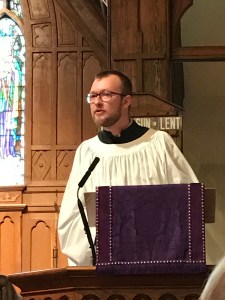
I preached this sermon at St. John’s Episcopal Church, Decatur, Alabama where I am doing my field education. I am blessed in having the opportunity to spend time with and learn from them every week. I am especially grateful for them recording my sermon which can be found by clicking here

         It’s fitting that Nicodemus comes to Jesus by night. The image of darkness creates a mysterious atmosphere, especially in our Lenten setting, one that hints at a time of uncertainty, a search for meaning, and further discernment.

Nicodemus came to see Jesus for a reason. Maybe because Jesus recently took the Passover festivities by surprise, angrily driving out the moneychangers from the temple with a whip and performing miracles.

Nicodemus says, “Rabbi, we know that you are a teacher who has come from God; for no one can do these signs that you do apart from the presence of God.”

Jesus responds, “Very truly, I tell you, no one can see the kingdom of God without being born from above.”

That kind of language is familiar to us; we’ve heard it all our lives. There’s a type of American revivalistic Christianity that attaches itself staunchly to this image as a way to describe the personal commitment of the believer. You have to be born again.

For many Christians, this statement implies a kind of conscious choice. “Are you saved?” is a question that implies that any Christian could make that decision for themselves.

But to Nicodemus it just sounds like a bad joke.

“Very truly, I tell you, no one can see the kingdom of God without being born from above.”

As Nicodemus becomes overly involved pondering the physical implications of Jesus’ statement (“one cannot enter a second time his mother’s womb”) Jesus begins to reassure him.

“Do not be astonished that I said to you, ‘You must be born from above.’ The wind blows where it chooses, and you hear the sound of it, but you do not know where it comes from or where it goes. So it is with everyone who is born of the Spirit.”

All of the sudden Nicodemus’ whole theological worldview has been completely upended, his spiritual world shaken.

To be born “from above” or of the “Spirit”…It’s not tangible.

It’s elusive—think of the wind in the trees.

You can’t see a gust of air, you know it only by the results of its presence. So it is with being born from the Spirit. You can’t see the Spirit itself, but if you pay attention you can see evidence of its work over time.

Jesus helps us identify the Spirit, not by giving us a strait-forward glimpse of it, but by offering an invitation for us to discern how it is at work in our lives.

Often, unless we pay really close attention, we don’t notice changes in ourselves or in the world around us until we look back and find the evidence.

We don’t see those changes occurring in ourselves each day, we only notice them when we reach for a photo album.

“Did my stomach really used to be that flat?!”

God’s creation might be evaporating right in front of our eyes. Our bodies might be subtly changing everyday. But we don’t recognize the change until we take time to look for the evidence.

Jesus invites us to see an unexpected perspective.

During this season of self-denial and repentance we are called to accept Jesus’s invitation to discern the work of the Holy Spirit in our own lives.

We are called to examine ourselves and our lives so that we too might recognize the moments of grace that open our eyes to Jesus—God’s saving gift to us—sent not to condemn us but to reveal in our likeness the promise of new birth.

It’s time to take stock of that grace.

Some people are really good at it, including my friend Pam. Each time I hear from her she tells me about how God has been working in her life.

It’s almost instinctive.

She tells me about her deliverance from health struggles. She talks to me about her daughter’s new job. It really is a spiritual gift I think, to be able to recognize God at work in your life like that.

Everyone should be so lucky as to have the ability to reflect in that way.

Nicodemus first visited Jesus because he was curious about Jesus’ teachings, and his spiritual outlook ended up drastically changing from a set of well-organized beliefs once he learned about this mysterious birth by the “Spirit.”

But it didn’t stop there.

He appears again a few months later (in chapter seven of John’s gospel) during the Jewish Festival of Booths.

The chief priests and pharisees are plotting to arrest Jesus, and as they argue with the temple police about the best method for doing so, Nicodemus speaks in Jesus’ defense.

“Our law does not judge people without first giving them a hearing to find out what they are doing, does it?”

He stands up for Jesus.

Give the man a fair hearing. It’s our custom. He at least deserves that.

And then several months later we meet Nicodemus again.

He accompanies Joseph of Arimathea to embalm Jesus’s body after it has been taken off the cross.

The scripture says, “Nicodemus came, bringing a mixture of myrrh and aloes, weighing about a hundred pounds. They took the body of Jesus and wrapped it with the spices in linen cloths, according to the burial custom of the Jews.”

He arrives to tend to the limp and broken body of the Lord.

Give the man a proper burial. It’s our custom. He at least deserves that.

Is this the same skeptical pharisee that appeared in the middle of the night? It would seem that his first visit to Jesus had quite an affect—a lot’s happened to Nicodemus since then.

I wonder if, the day Nicodemus laid Jesus in the tomb, he thought back on that first time he met with him.

I wonder if he’d recognize himself?

I wonder if he’d recognize the Spirit’s work in his life.

I wonder if, as he laid Jesus in the tomb that day, he’d hear the wind rustle the treetops and think of a birth, his birth, from above.

Help My Unbelief!

February 20, 2017 – Mark 9:14-29 

You can watch and listen to this sermon by clicking here.

Take a trip with me back to Mark chapter six. Jesus called the disciples, “and began to send them out two by two and he give them authority over unclean spirits.”

Their confusion is understandable, then, when in chapter nine they ask, “Why could we not cast it out?” It says right there that he gave the Twelve authority over demons.

So why didn’t it work with this boy?

Jesus’s answer is revealing: “This kind can only come out through prayer.”

“Teacher,” the boy’s father calls, “I brought you my son; he has a spirit that makes him unable to speak; and whenever it seizes him, it dashes him down; and he foams and grinds his teeth and becomes rigid; and I asked your disciples to cast it out, but they could not do so.”

Again, Jesus’ response is revealing. “You faithless generation, how much longer must I be among you? How much longer must I put up with you? Bring him to me.”

“You faithless generation!”

We don’t know how exactly he said it. We don’t have any “non-verbal” clues. It can be tempting to manufacture our own, but forget any imagined tone of voice—just look at the words.

“How much longer much I put up with you?”

“This kind can only come out through prayer.”

The disciples and the scribes had been arguing, but their arguments only point toward themselves, a natural response when we feel like we’ve got something to prove.

While attempting to defend their own efforts, they forgot that it’s really about prayer.

“If you are able to do anything, have pity on us and help us,” the father cries.

He’s in an impossible situation. He’s come to a group of supposedly-certified healers and they’ve not been able to do anything for his son.

His faith it’s at the breaking point. “If you can do anything, Jesus, please just do it!”

That “if” language doesn’t exactly exemplify the unblemished faith that we all strive for, but nevertheless it is the reality of our own days and nights.

Every day we stare into the faces of faithless people, and we too lose faith. In an effort to reclaim that faith we often look to ourselves. Sometimes we are as sure as we can be that we will be saved by our own efforts, that we have all the prayers, all the faith—ALL it takes.

It’s not about winning an argument in order to *prove* that we have the ability. It’s not about us.

It’s about prayer, and faith, and God.

Jesus tells each of us: you have the power to be self-aware enough to recognize that it’s not about you.

He reminds us that we still need God.

He reminds us not of the basic truth that God can do anything through us, but rather he calls to mind the complex realization that we cannot do anything without God.

We depend on a God who wants what is best for us.

Do you hear it?

Our participation in God’s glory is not limited to our inwardly-focused testimony, “I believe.”

Rather it is more fully realized in the courage of our humble refrain: O God, “Help my unbelief!”

Experiencing The Joy

December 25, 2016 – Luke 2:1-14

Thanks to the fine folks at my home parish, you can watch me preach this sermon here. The sermon starts at 7:30.

Merry Christmas!

And what a merry occasion it can be. The good news for us is, even in the silence we can experience it.

Eh, maybe music would be nice, but we’ve done that. The organist is with his family. The choir members are home watching their children rip open the packages from Santa. Members of the Alter Guild are playing with their grandchildren.

Phillips Brook’s is pretty eloquent. He wrote “O Little Town of Bethlehem.”

“How silently, how silently, the wondrous gift is given; so God imparts to human hearts the blessings of his heaven. No ear may hear his coming, but in this world of sin, where meek souls will receive him, still the dear Christ enters in.”

Yes. We’re fine.

We don’t always need an organ pipe blaring to broadcast the “still small voice of God.”

The truth is, try as they might, no trumpet fanfare could do such a voice justice. No organ riff could measure up to it, breaking forth in the chilly air, hay rustling beneath the tiny newborn limbs.

If you listen closely enough, you might just hear a little bit of it.

It’s much more than the voice of a baby.

I saw a woman in the grocery store this week. You’ve probably seen her, too. The woman who is pushing a cart full down the aisle and she has quite a long list in her hand, written out on the back of last month’s receipt. She looks stressed, confused even, by the time she gets to the relishes. Why do there have to be so many brands of pickles?

Another woman was pushing her cart the opposite way, she’s considerably younger, and there’s a baby in her cart.

For a moment it all just stops.

The older women locked eyes with the young child and they smiled at each other and she waved to him and he giggled and she forgot where she was or that she had a list or that the prices had gone up.

Everything was right there in that moment. It was unexpected joy. Mountains of things to buy and do, but she had to stop and make funny faces at him for a while.

It took her from that place. She’s somewhere else.

The other stuff will be there when they’re done.

Do you know anyone who has a cat or a dog? And it just comes and sits down in the lap whenever it feels like it?

My friends sometimes post pictures on Facebook: With a computer in their lap, books open on the table, and Scruffy plops himself right down, sprawls along the keyboard.

It’s annoying! Get off. I’m trying to finish these reports!

Well, maybe.

But what a joy. It alleviates something. It takes you away.

“Oh! I love this little guy!” And that love is unconditional.

The other night my mom texted—it was a group text to the whole family. It was a picture of a photograph of our dog, Winston, hanging on the refrigerator. It was from several Christmases ago, and he was all dressed up in his reindeer costume. We lost Winston earlier this year.

“Cheered me up before leaving the house today,” she wrote.

She was somewhere else, just for a moment.

My friend Richard, he’s such a character. I really love him, but we can sure get stuck in some places.

“How are you doing today Richard?”

He mutters, smiling, quoting a local author, “Oh Warren, we live in a fallen world.”

“Well, yes we do Richard.”
“Gosh, the burden of existence is just so much sometimes!”

“Yeah, Richard…I hear ya.”

It’s easy to get down in these things. It’s easy read a news headline on your phone or a glance at a ticker on the bottom of a cable news channel while you’re waiting on your oil change and you’re just done. You’ve bottomed out. I don’t know if what I’m dong in life makes sense anymore. Onerous troubles creep to mind and you become more aware of the fall than you are of any hand extended to help you up.

But tell a good joke, use a funny accent, or quote 30 Rock at just the right time, and Richard laughs so hard, just loses it. I’ve got videos on my phone to prove it. He can’t keep it together. It’s hard to breathe, you’re abs start to hurt when you laugh that hard.

It’s a joyful episode. 

For some people, their whole lives have become so predictable, their activity has become so restricted, that the day their granddaughters come into town and visit them, they finally have something wonderful to talk about instead of everyone’s aches and pains or who died this week. For just a moment, they leave all that negativity aside and focus on the joy.

If we go through life thinking only of that which we have to peel off the bottom of our shoe, we miss the dew-drenched meadow at dawn that we walked through to get it.

There’s plenty to get us down. It seems all too real. It is all too real. Then, Christmas bursts in. Christmas reminds us that joy is also real. It’s too easy to get stuck in the junk of life and forget about—or miss—the joy.

Jesus walks the same path we do during the liturgical year. He walks it with us. Through times of repentance and anguish and temptation and examination and expectation, but also times of joy—and that’s what it’s time for now.

We’ve had our Advent. We’ll get our Lent.

Let us settle in to the joy of God’s immanence. 

That’s what it’s time for now.

This joy does not impede our witnessing the occasions of suffering darkness, but it does helps us forge a Way with Him to walk.

When you walk out of the Eucharist today many things will still be the same.

The homeless man will still be standing at the bottom of the exit ramp.

The children of Aleppo will still be experiencing shock waves of relentless terror.

By any standard of American democracy the men and women who won on Nov. 8th will still be victors, and those who lost will still be losers.

But there will be one difference—you have been here—in the midst of the miracle.

You have sat here and experienced the silent joy of the incarnation.

You have met Him (in the body and the blood).

Cold. Alone. Scared. Helpless. Human. Hungry. Giggling. Remembering. Laughing. Loving.

This is a joy that transforms the moment. This is a joy so full and complete that it transports us away from our reality and into the heart of God.

A joy that knows no boundary

A love that knows no condition.

A peace that passes all understanding.

And…here’s what’s really cool—you can take all that with you when you go.